Field Boundaries and Faded Ballast: Walking Alford’s Railway Ghost
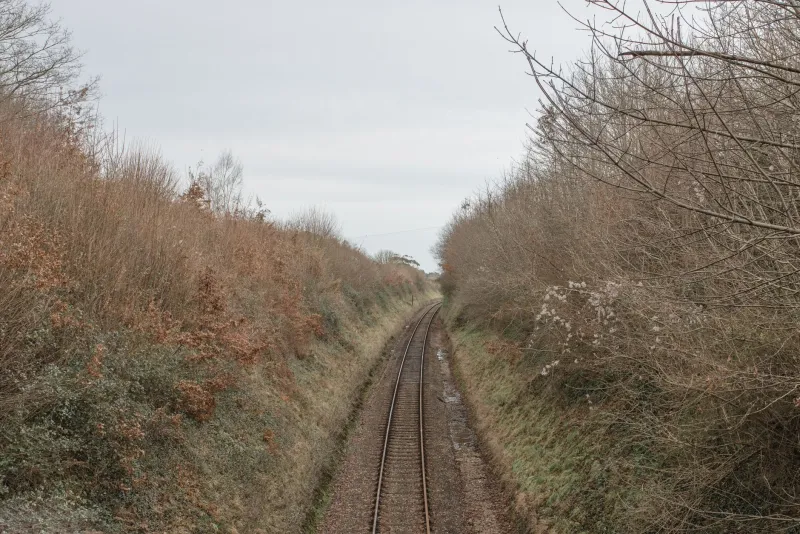
On a damp November morning, Alford can feel a long way from any railway. There is no station sign, no timetable flapping in the wind, no distant rumble behind the houses. Yet the old line has not disappeared completely. It has simply gone quiet, folding itself into field edges, footpaths and the straight, stubborn lines that still shape the land around the village.
This is not a walk for pretending you are on a train. It is a walk for noticing what remains — and for understanding why the railway mattered to a place like Alford. The East Lincolnshire Railway served the village for generations before passenger services were withdrawn in 1970. The tracks were lifted, the station site was reworked, and the corridor became something else. In 2026, the best way to read that change is on foot, with an OS map, a pair of decent boots and a healthy respect for other people’s land.
Start Where the Station Isn’t
The obvious beginning is the old station area, where the modern street pattern gives away more than any plaque. Look for the wide gaps between buildings, the oddly generous road bends and the names that keep pointing backwards: Station Road, Station Yard, the sort of practical labels that outlive the thing they describe. The station itself is gone, but the approach to it is not. You can still feel how people would have arrived — on foot from the village, by cart, later by car — and how the railway sat just slightly apart from the old centre rather than cutting through it.
Stand there for a moment and resist the urge to hunt for a platform edge. The clues are subtler. A long boundary wall. A flattened strip of ground. A garden that seems to run along a line rather than around one. Alford’s railway history is not a museum exhibit; it is a set of echoes.
Reading the Ballast
Once you leave the built-up edge, the old corridor begins to reveal itself in the landscape. Railway engineers liked gentle curves and steady gradients, and those habits leave a signature. Hedges run straighter than they should. Field boundaries thicken along a line that has nothing to do with a modern plough. Embankments rise and fall with a certain tidy purpose. Underfoot, especially after rain, you may find small, angular stones that look out of place in heavy Lincolnshire soil — ballast, or what is left of it, scattered like loose change.
The temptation is to follow every scrap. Don’t. Much of the old route is private land, and a lost railway is not a public right of way just because it is interesting. Use the definitive map and local footpath network. In Alford, OS Explorer 274 is the sensible starting point, but treat it as a guide rather than a guarantee. Paths move, gates change and crops rotate. If a route looks blocked or ambiguous, take the legal alternative rather than the adventurous one.
The Bridges That Still Carry Shadows
One of the quiet pleasures of this walk is the bridges. Some are small accommodation bridges, built so farmers could move livestock from one side of the line to the other. Others are larger, with brickwork that still looks purposeful despite decades of weather. Stand beneath one and you can imagine the sound of a train passing overhead — not because the bridge is dramatic, but because it is so ordinary. These were working structures, built to solve practical problems, and they have outlasted the thing they were built for.
Do not climb on them, and do not assume a bridge is safe just because it is old. Look from a distance. Notice the soot-blackened brick, the moss on the north side, the way a hedge has crept along the parapet. These are the trackside details most people miss: not grand relics, but small evidence of use and neglect.
A Route for 2026
A sensible circular walk is about three to four miles, depending on where you start and how often you stop to peer over gates. Begin near the old station area, follow public footpaths that shadow the corridor where possible, and use field tracks to link back towards the village. The route should take two to three hours at an unhurried pace, longer if the ground is wet or you keep stopping to read the map.
Go in daylight, carry a torch in winter, and wear boots you do not mind getting muddy. Several sections will be soft underfoot after rain, and the low November sun can make road sections harder to see. Keep dogs on leads around livestock, close gates behind you, and stay on the path even when the old railway line looks temptingly clear. If you meet a farmer, say hello. A friendly word does more for access than any amount of map-waving.
Small Details Most People Miss
Look at the field names on older maps, where words like Railway Plantation or Station Field often survive long after the rails have gone. Look at garden walls that contain a suspiciously uniform brick, or sleepers reused as steps and edging. Look at the way trees line up along a boundary, as if they were planted to mark a route rather than simply fill a gap. Look at the hedges: hawthorn, ash, sycamore and the occasional spindle, all growing along a line that was once kept brutally clear.
These details do not prove anything on their own. Together they tell a story about how a village absorbs a railway into its everyday life — and then absorbs its absence.
The Memory in the Pub
Ask around and the railway comes back in fragments. Someone’s grandmother used the train for market. Someone’s father worked on the line. Someone remembers the closure as a rumour that turned out to be true. These are not tidy oral histories; they are the sort of memories that surface over a pint or in a queue at the shop. They matter because they remind us that the lost line was not just an engineering corridor. It was a way people got to work, to school, to the coast, to the rest of their lives.
Walk It Respectfully
The old railway is a good walk precisely because it is not a theme park. There are no turnstiles, no audio guides, no gift shop at the end. There is just a village, a set of fields and a line that left. Take a map, take your time, and take nothing but photographs. If you find a piece of ballast, leave it where it lies. The next person deserves to notice it too.