Road Signs and Old Field Lines: How Alford’s Street Names Tell the Village’s Story
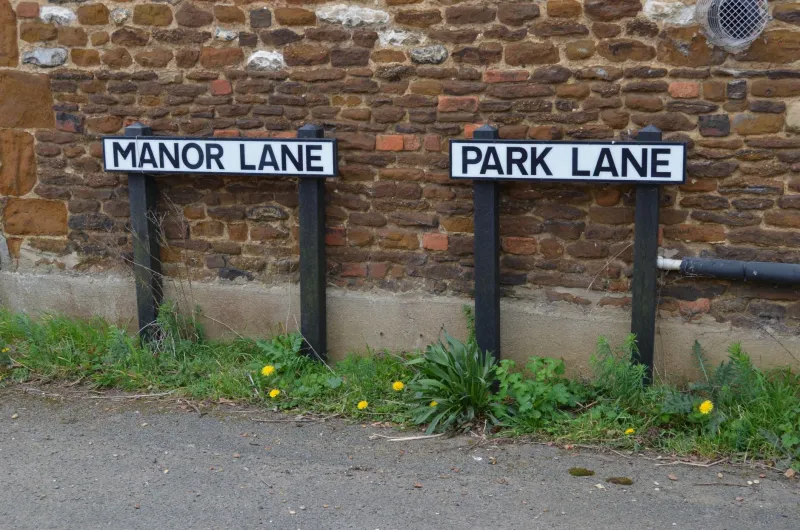
Street signs are the least-read literature in any village. We pass them every day — on the school run, on the way to the shop, on the slow loop back from the butcher — and yet most of us could not say why a particular lane is called what it is. Alford’s street names are a paper trail written in metal and paint. Some are brutally practical. Some are medieval echoes. A few sound like they were chosen by a developer with a brochure open on the desk.
The plainest names do the heaviest lifting
Start with the obvious ones. Market Place, High Street, Church Street, South Street, East Street, West Street. There is no mystery here, and that is rather the point. These are names that tell you exactly where you are and what happens there. Market Place was the commercial heart; Church Street led to the church; the compass points did the rest.
They are not poetic, but they are honest. In a village like Alford, that honesty is part of the charm. You do not need a plaque to explain that the High Street is high, or that South Street runs south. The names are directions, not riddles.
Roads that point somewhere else
The next layer is more interesting. Bilsby Road, Willoughby Road, Rigsby Road, Farlesthorpe Road, Tothby Lane. These are not descriptions of the street itself; they are promises about where it goes. Before satnav, a road name was a sentence: keep going and you will end up there.
Tothby Lane is a particularly good one to linger over. Tothby is one of those places that exists more firmly on old maps than on modern ones — a hamlet, a field name, a memory of a settlement. The lane still carries the name even if the place it points to has largely slipped away. That is how street names work. They are fossils, and sometimes the creature they belonged to has long since vanished.
The railway left more than a cutting
Station Road is another name that does a lot of quiet work. The railway reached Alford in the middle of the nineteenth century, and for a while the station was a gateway to the wider world. The trains have gone, but the road name remains. Victorian cottages and terraces nearby still carry the shape of that period — modest, practical, built for people who worked within walking distance of the line.
You can read a whole social history in that one word: station. It speaks of timetables, parcels, school journeys, livestock, and the slow disappearance of a branch line that once felt permanent. Residents of a certain age still remember the sound of it. Younger ones simply know the name and wonder why there is no station at the end of the road.
Field boundaries in disguise
Some of Alford’s older names come from the landscape that existed before the streets did. Field boundaries, footpaths, chantry lands, enclosure lines — all of these can survive in a street name long after the hedges have been grubbed out and the houses built.
Chauntry Road is a good example of a name that carries a medieval echo. A chantry was an endowment left for priests to say Mass for the dead. It is the kind of word that reminds you Alford’s history did not begin with the Victorian brick or the modern estate. The village has been reorganising its land for centuries, and each generation leaves a layer behind.
In Lincolnshire, we also have the old habit of calling a road a “gate” — not a barrier, but a way through, from the Old Norse gata. Even where that word has fallen out of everyday use, the shape of it lingers in the landscape. Street names are often the last place a lost dialect survives.
Orchards, mills and the modern cul-de-sac
Then there are the newer names. Developers love a bit of rural nostalgia. If a cul-de-sac is called Orchard something, there is a decent chance an orchard once stood there — or at least that someone thought it would sound nice. Mill Lane, Beck Close, Meadow Way: these names borrow from the landscape that was there before the tarmac.
Sometimes the borrowing is accurate. Sometimes it is pure invention. That is not necessarily a bad thing. A new street name can act as a small act of remembrance, even if the memory is thin. But it can also leave residents scratching their heads. A name that sounds old is not the same as a name that is old.
The mystery names worth solving
Which brings us to the question we keep coming back to: are there any modern Alford street names that still feel like a puzzle? A name that nobody can quite explain? A cul-de-sac that seems to have arrived from nowhere, or a lane whose name does not match any old map we can find?
We would like to hear about them. Not every mystery needs a grand answer. Sometimes the truth is simply that a developer liked the sound of a word, or that a council committee chose something in a hurry. But those small decisions are part of the village’s story too.
Send us your paper trail
If you have old maps, deeds, photographs, postcards or trade directories tucked away in a drawer, we would love to see them. You do not need to hand over priceless originals — a phone photograph is plenty. We are especially interested in tithe maps, enclosure maps, old Ordnance Survey sheets, and any street directories that show Alford before the newer estates arrived.
And if you remember a street before it was named, or you know why a particular lane carries the name it does, tell us. Memory is a kind of map too.
You can get in touch through the contact link on alford.org.uk, or catch us at the next village noticeboard gathering. We are building a small archive of Alford’s street-name stories, and every scrap helps. After all, the signs are already there. We just need to learn how to read them.